Macbett’s coronation and marriage to the witch disguised as Lady Duncan
The KillerMacbett’s coronation and marriage to the witch disguised as Lady Duncan make political succession a spectacle—and then expose the spectacle as fraud. The crowd hails a king and bride in state robes, crowns, and purple, while the actual Lady Duncan has been imprisoned and a sorceress has taken her face, voice, and body. The ceremony appears to secure Macbett’s new rule; the bride’s private change back into a witch reveals how unstable that public image is.
From welcome to ceremony
The sequence opens in a palace room as a crowd cheers for Macbett and his bride. The real Lady Duncan, introduced as the future Lady Macbett, enters with Macbett but without royal attributes. She thanks him for escorting her to her apartments and says she is tired after her exertions. Their exchange lays out the day’s program: the marriage ceremony is set for ten o’clock, the coronation for midday, and a wedding feast for five. The schedule lends the usurpation the reassuring shape of official routine, even as the audience has reason to question who the bride really is.
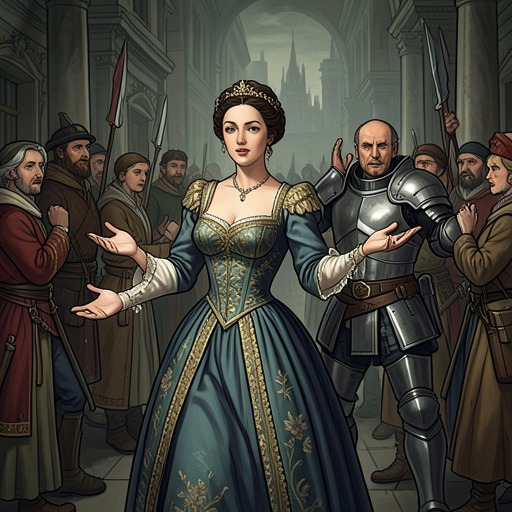
At the later public appearance, the couple wear robes of state, crowns, and purple robes; Macbett carries his scepter. Bells ring as they stop at center stage with their backs to the audience and wave to the crowd on either side. The acclaim extends beyond them: some voices hail the Archduke and Archduchess. The sequence makes rule visible through regalia, ceremony, and collective cheering. Yet the public image is deliberately vulnerable to what the audience knows—or is about to learn—about the woman wearing the crown.
A claim of control
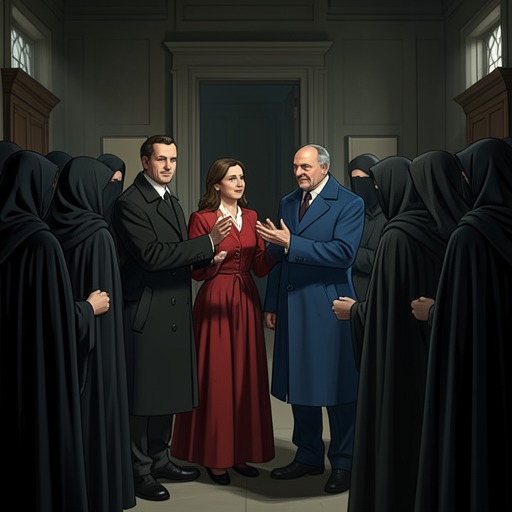
In the midst of the celebration, Macbett tells his bride that he has canceled her prediction and discovered her arrangements. He says he has taken steps to prevent her from keeping the upper hand. The exchange places an assertion of mastery inside the royal pageant: Macbett presents himself as someone who has anticipated a threat and neutralized it. The bride answers that she can explain, but not in public. He postpones the discussion, takes her hand, and the pair leave smiling as the cheering continues.
The scene does not establish exactly what prediction Macbett means, or how far his countermeasures extend. Its dramatic force lies in the confidence of his claim and the concealment implied by her answer. Their public unity depends on keeping the dispute out of sight; the royal performance continues while the truth of the marriage remains unresolved.
The bride sheds her royal appearance
After the couple leave, the stage is empty before the supposed Lady Macbett returns with her lady-in-waiting. The attendant praises her bearing during the ceremony and says the crowd admired the couple. The bride replies that Macbett has gone to sleep after drinking too much and that the wedding feast is still ahead. She urges the attendant to hurry, then throws away the sacred crown and removes the cross necklace, saying it has been burning her and that she has a wound on her chest which she has covered with curses.
Her transformation makes the gap between ceremonial identity and concealed identity concrete. The attendant opens a case and takes out a witch’s costume. As she is changed, the bride describes the cross and the white dress as painful, says she spat out the Host that had stuck in her throat, and recalls nearly fainting when she was made to touch icons. She also says she managed to kiss one, despite finding it disgusting, and asks for spiced, magic vodka, which she says is like mineral water to her. These details turn the bride’s sacred regalia into something she has endured as part of a disguise rather than embraced as a genuine religious or royal identity.
The stage directions complete the change through the body and its costume: the woman puts on an old, smelly dress and a vomit-covered apron, replaces her hair with dirty gray hair, removes her teeth, displays the plate, and puts on a pointed nose. The transformation is not merely an explanation delivered in retrospect; the audience sees the apparent queen stripped of crown and white dress and remade as a witch. The First Witch urges haste, and the Second Witch replies that she is hurrying. The First Witch says they are expected.
Escape and exposure
The witches’ departure turns the costume change into an escape. The First Witch calls for flight and mimes steering from the case while the Second Witch spreads her arms like wings. A blackout leaves a spotlight on the case, which appears to fly. The royal celebration has thus produced not a secure marriage but the departure of the impostor and her companion, with the throne and palace left behind as the setting for the next gathering.
The deception is fully stated when the real Lady Duncan confronts Macbett at the banquet. She denies that the wedding was hers: the woman whom the guests saw marry Macbett was a sorceress who had taken her face, voice, and body. The witch, she says, threw her into the palace dungeons and chained her there; moments earlier, the chains fell and the bolts drew back as if by magic. Lady Duncan rejects any complicity in Macbett’s rule and calls him the murderer of his master and friend, an usurper and an impostor. Her return exposes the wedding not as a union with Duncan’s widow but as a public substitution performed while the real woman was captive.
Significance of the pageant
The event sets public recognition against private reality. Crowds can acclaim Macbett and his bride, and the visible signs of sovereignty can be arranged with precision, but those signs do not establish the bride’s identity or the legitimacy of the succession. The crown and cross, first displayed as part of the royal appearance and then discarded as sources of pain, become props in a performance the witch must escape. Macbett’s claim that he has canceled a prediction is likewise unsettled by the bride’s concealed arrangements and flight.
The sequence also makes the wedding’s political violence difficult to separate from its ceremony. The real Lady Duncan’s account links the celebratory marriage directly to imprisonment and usurpation; her appearance at the feast overturns the identity the crowd had accepted. By staging the bride’s unmasking through costume, bodily transformation, and escape, the play makes the coronation’s apparent triumph temporary. The public image of a new royal couple survives only until the woman beneath the regalia can speak.